Mouth Breather Face: How Breathing Changes Your Jaw and Face

"Mouth breather face" is one of the most searched terms in looksmaxxing — the idea that breathing through your mouth instead of your nose slowly changes how your jaw and face develop. It's a real area of orthodontic research, and it's also one of the most exaggerated claims online. This guide separates what's genuinely evidence-based from what's hype.
We'll cover what the term means, the actual signs, why it happens, and — most importantly — what you can and can't change depending on your age. If you'd rather just see the measurements, a free AI face scan reads your jaw, midface, and 40+ other facial ratios in about 30 seconds.
Curious where you actually stand?
Get your free AI face score in 30 seconds.
What does "mouth breather face" mean?
"Mouth breather face" describes a cluster of facial traits that orthodontists have long associated with chronic mouth breathing during childhood growth. The clinical term is 'adenoid facies' or 'long face syndrome' — a well-documented pattern, not an internet invention.
The core idea: the resting position of your tongue and the way you breathe apply gentle, constant forces to the growing bones of your face. When a child breathes through the nose with the tongue resting on the roof of the mouth, those forces encourage the upper jaw (maxilla) to grow forward and wide. When a child breathes chronically through the mouth — often because of allergies, enlarged adenoids, or a deviated septum — the mouth stays open, the tongue drops low, and the growth pattern shifts.
What causes mouth breather face?
Mouth breather face isn't caused by the breathing itself so much as by whatever is blocking the nose and forcing the mouth open during the growth years. Fix the cause early and you address the whole problem. The usual culprits:
- Chronic nasal allergies or long-term congestion (the most common cause)
- Enlarged adenoids or tonsils blocking the airway
- A deviated septum or other structural nasal obstruction
- Chronic sinusitis that keeps the nose stuffed
- Tongue-tie (ankyloglossia) that stops the tongue resting on the palate
Signs of a mouth breather face
No single feature confirms it — it's a pattern that tends to appear together. Common signs orthodontists look for include:
- A longer, narrower face (increased lower-face height)
- A recessed or weak-looking chin and jaw (less forward growth)
- A flatter midface and less prominent cheekbones
- A narrow upper jaw, often with crowded teeth or a high, narrow palate
- Lips that rest slightly apart at rest ('lip incompetence')
- Under-eye darkness or slight puffiness from poor sleep quality
- A gummy smile or more visible upper teeth
Signs you're mouth breathing at night
The facial signs above build up over years — but you can catch mouth breathing itself much sooner from how you sleep and wake. If several of these sound familiar, you're likely breathing through your mouth at night:
- Waking up with a dry mouth or reaching for water in the night
- A hoarse or scratchy voice first thing in the morning
- Frequent snoring (yours or reported by a partner)
- Bad breath that comes back quickly soon after brushing
- Waking unrefreshed and feeling tired through the day
Mouth breather face vs nose breather face
The nose breather pattern
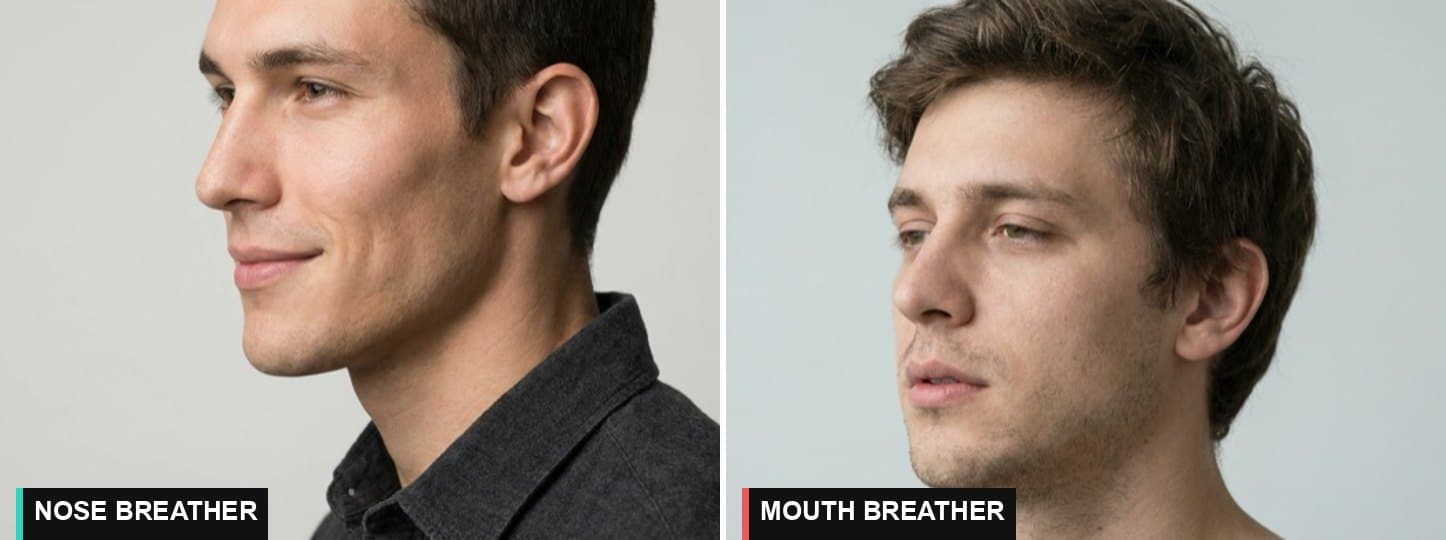
Habitual nasal breathing during growth is linked to broader, more forward facial development: a wider palate, more forward maxilla and mandible, stronger cheekbone support, and a shorter, more compact lower face. This is the 'forward growth' look that looksmaxxing communities prize — and it's largely set during childhood and adolescence.
The mouth breather pattern
Chronic mouth breathing is associated with the opposite: downward-and-backward growth, a longer lower face, and a less defined jawline. Importantly, correlation is not destiny — genetics, ethnicity, and dozens of other factors shape your face far more than breathing alone. Plenty of nose breathers have long faces and plenty of former mouth breathers have sharp jaws.
What the science actually supports (and what it doesn't)
Here's the honest version. The link between chronic childhood mouth breathing and altered craniofacial development is supported by orthodontic research — this part is real. Nasal breathing and correct tongue posture during the growth years genuinely matter for how the jaws develop.
What is NOT well-supported: the claim that adults can dramatically 'reverse' their bone structure through tongue exercises, thumb pulling, or 'mewing'. Your facial bones finish the vast majority of their growth by your late teens. After that, the sutures fuse and the bones are stable. Any influencer promising that a breathing trick will 'cure ugliness' or reshape an adult skull is overselling. Be skeptical of anyone selling a guaranteed transformation.
How to fix mouth breathing (and how much it helps)
For children and teens
This is where it matters most. If a child breathes through their mouth chronically, the first step is a real medical one: see an ENT and a dentist or orthodontist. Enlarged adenoids or tonsils, allergies, and a narrow palate are treatable, and correcting the underlying cause while the face is still growing can meaningfully influence development. This is not a DIY project — it's a medical evaluation.
For adults
You can't re-grow your jaw bones, but switching to consistent nasal breathing still delivers real, worthwhile benefits: better sleep quality, less under-eye puffiness, reduced daytime fatigue, and a more relaxed, closed-lip resting face. Fix the actual cause of mouth breathing (allergies, congestion, a deviated septum) rather than forcing it. Lean body composition, good sleep, and posture do more for how your jawline reads day-to-day than any tongue exercise.
The bottom line
Mouth breathing during childhood is a legitimate factor in facial development — the term isn't a myth. But your adult face is the product of genetics and dozens of factors, and no breathing hack rebuilds an adult skull. Focus on what's real: breathe through your nose, fix the underlying cause if you can't, sleep well, and stay lean. If you're a parent, chronic mouth breathing in a young child is worth a doctor's visit, not a panic.
Curious where your own jaw, midface, and proportions actually land? An AI face scan measures them objectively in seconds — far more reliable than judging yourself in a mirror.
See your jaw and midface measured
Get your exact jaw, midface ratio, and 40+ facial proportions with a free AI scan — 30 seconds, no signup, no guessing in the mirror.
Analyze My Face Free100% free · No signup · Takes 30 seconds
Frequently Asked Questions
Is 'mouth breather face' a real thing?
Yes — it's based on a documented orthodontic pattern called adenoid facies or long face syndrome. Chronic mouth breathing during childhood growth is linked to a longer, narrower face and less forward jaw development. The concept is real, though it's often exaggerated online.
Can mouth breathing face be reversed?
Partly, and it depends on age. In children and teens whose faces are still growing, correcting the cause of mouth breathing (allergies, adenoids, a narrow palate) can genuinely influence how the face develops. In adults the bones are set, so you can't reverse the skeletal structure — but switching to nasal breathing still improves sleep, under-eye puffiness, and your resting closed-lip face. Ignore anyone promising a full adult 'reversal' from a breathing hack.
Does mouth tape fix mouth breather face?
No — mouth taping keeps your lips closed at night but it doesn't fix the reason you breathe through your mouth (a blocked nose, allergies, adenoids, or a deviated septum). The evidence is limited and mixed, and it can be dangerous for anyone with sleep apnea, heavy snoring, or nasal obstruction. Treat the underlying cause first, and only try taping with medical clearance.
Can you fix a mouth breather face as an adult?
You can't re-grow adult jaw bones, but switching to nasal breathing improves sleep, reduces under-eye puffiness, and gives a more relaxed closed-lip resting face. The dramatic 'reverse your bone structure' claims from some influencers are not supported by science. Facial bones are largely set by your late teens.
What are the signs of a mouth breather face?
A longer lower face, a recessed or weak chin, a flatter midface, a narrow palate with crowded teeth, and lips that rest slightly apart. No single feature confirms it — it's a pattern that tends to appear together.
Does nose breathing change your face?
During childhood and adolescence, yes — habitual nasal breathing with correct tongue posture is linked to broader, more forward facial growth. As an adult, breathing won't reshape your bones, but it does affect sleep, puffiness, and how rested your face looks.
Is mewing or thumb pulling backed by science for adults?
No. Adult facial bones finish growing by the late teens and their sutures fuse, so tongue exercises or thumb pulling won't reshape an adult skull. Correct tongue posture and nasal breathing matter most during childhood growth. Be cautious of anyone promising an adult transformation from these techniques.